I recently came across some comments suggesting that it would be better for Peru to be led by a power like the United States rather than by a country like China, whose culture is said to be too distant from Peru.
Upon reflecting on this statement, I see a few issues. First and foremost, the ideal scenario is that Peru shouldn’t be led by any foreign power, but rather be strong and independent enough to forge strategic alliances with global powers based on mutual benefit and respect.
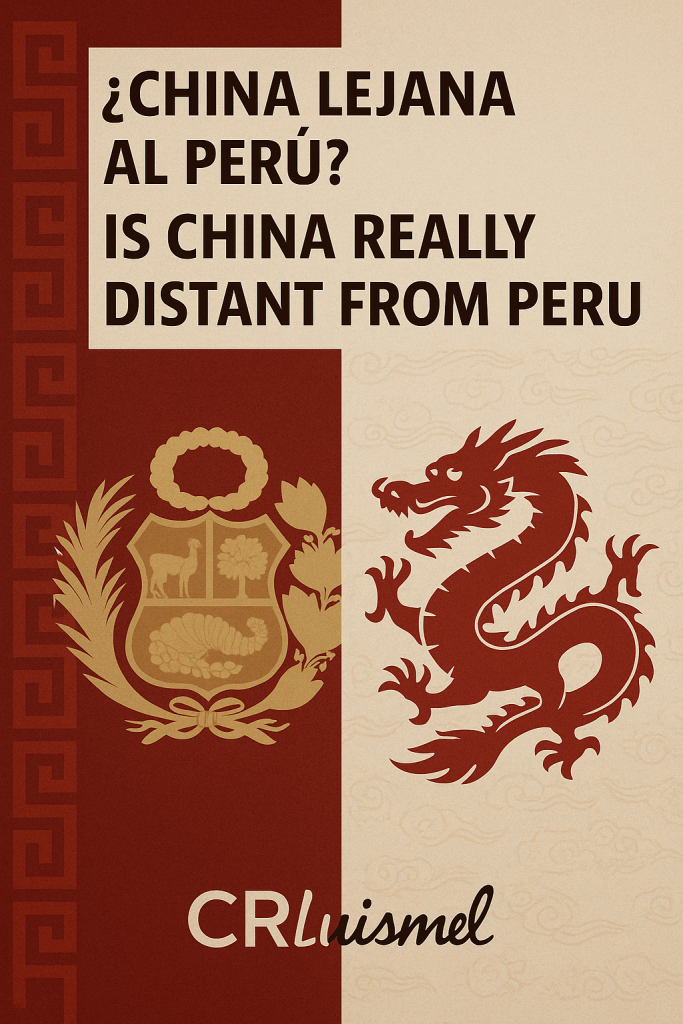
That said, despite the Peruvian geographic proximity to the United States, Chinese culture is far more deeply rooted in Peru than many people realize, and here’s why:
A vital part of Peru’s rich, diverse identity —born from centuries of cultural blending— includes the genetics and customs brought by Chinese migrants, some of whom arrived as early as colonial times.
Chinese communities have been in Peru for almost as long as many other migrant groups, and their descendants are proudly Peruvian. Their legacy is everywhere: in the Barrio Chino of Lima, in every chifa around the country, in our comida criolla, in the little corner stores we fondly call “el chinito’s,” in our schoolmates or neighbors of Chinese heritage, and even in that chinita bonita we once dedicated love songs to. China is not foreign to Peru — it lives in our streets and kitchens.
Many of us have studied or worked alongside Chinese-Peruvians. We’ve witnessed their admirable discipline firsthand. They open shop even on holidays, smoke their cigarettes with intensity, read newspapers in Mandarin that we can’t quite figure out where they get, eat clean, and often heal themselves with natural remedies passed down through generations — secrets they may share only with those they trust.
The earlier waves of Chinese immigrants often arrived before China’s major social and political revolutions of the 20th century. However, even today, new Chinese immigrants share a familiar work ethic and discipline — with one major distinction: they now operate under a social structure that emphasizes loyalty and fidelity to their government.
This loyalty —and the broader sense of social unity it fosters— is something that may be lacking in other cultures, including Peru’s. It’s worth contemplating whether such cohesion could help us move forward as a society.
Interestingly, I’ve heard of second- or third-generation Chinese-Peruvians traveling to China to reconnect with their roots, only to realize how different things have become. It’s not a negative experience — just one that requires re-learning and re-adapting to fit into modern Chinese society, where education is strict, life is highly disciplined, and loyalty to the state is a vital part of belonging.
This raises a broader question: if countries increasingly demand full loyalty, what happens to people with multiple nationalities? I, for one, hold dual citizenship, and so far, I’ve never experienced a conflict of interest — thanks to diplomatic cooperation between nations. But I’m aware that things could change one day, and I might be asked to choose. I hope not, because I value the privilege of belonging to more than one nation, and I may even acquire a third.
I deeply respect China and its beautiful people, just as I respect other nations that prioritize the well-being of their citizens — not just the ruling class — and manage their economies wisely.
So I conclude this reflection with the firm belief that Peru, in full sovereignty, has the right to build alliances with any power it deems appropriate, so long as it protects its key resources and always puts Peruvians first — just as foreign powers do for their own people.
—
CRLuismël
2025-05-17