By C.R.Luismël
Originally posted on February 15, 2025, on my social networks, now expanded and adapted for my blog
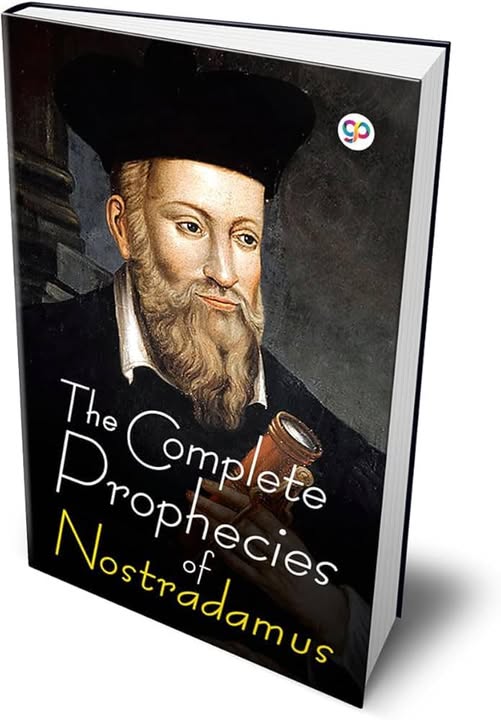
When we talk about Nostradamus’ prophecies, many of us instinctively accept that he was a prophet. But have you ever actually read his famous quatrains?
How many of us can truly say we’ve seen undeniable references there to historical events that have already happened?
Today, when a single click gives us access to virtually any book ever written, it seems a sign of intellectual laziness to keep blindly believing what we were told long ago, without bothering to investigate for ourselves.
I mean no offense to scholars and experts on the subject. But judging by the classic documentary narrated by Orson Welles —which haunted many of us in my generation when it aired on public TV during our childhood— I still feel those quatrains have little or nothing to do with the historical events they’re claimed to predict.
At first, I thought maybe I just wasn’t intelligent enough to grasp the connection. But now, well into my forties, it seems I’ll never develop that level of intelligence… or perhaps that connection simply doesn’t exist.
So perhaps instead of seeing Nostradamus as a prophet, we might see him as a man of remarkable eloquence and imagination, who —in an age where free thought was perilous— chose to express himself through enigmatic verses.
Reading his quatrains, it becomes quite clear to me that they cannot be solidly linked to specific historical events or predictions.
Yet, interpreters continue to emerge, tying them to phenomena as recent as COVID-19, or even to episodes of The Simpsons. Today, even streaming platforms feature new documentaries revisiting his so-called prophecies.
On prophets — and the weight of the word
It’s essential to be cautious with what circulates in documentaries or on social media, where theories without solid foundation are often presented as fact.
Speaking of prophets, in the full sense of the word, means speaking of people with a magnificent, almost divine ability to deliver messages to humanity — people chosen by higher forces to see beyond the obvious. Let’s also remember that to prophesy and to profess are by no means synonyms.
Historically, prophets held privileged positions, finding their way to kings, rulers, and emperors to deliver messages that would impact vast populations. This was in times when most people could barely read or write, with no radio, no newspapers, not even effective smoke signals.
Nostradamus, as we know, had contact with the powerful people of his era. After experiencing tragic events in his life, he retreated and dedicated himself to writing and publishing his quatrains in 16th-century France, a pursuit that continued up to his death, including a posthumous publication. His verses are organized into “centuries,” suggesting that he was writing about events spanning ten centuries, or a thousand years beyond his lifetime.
Historical context: more poet than seer?
Let’s step back into his time: Michel de Nostradamus lived before Galileo Galilei. The French were already sailing to the Americas, financing expeditions left and right. Everything was weighed under the notion of sin, and heresy could get you burned at the stake.
It’s curious, then, that Nostradamus managed to publish a book titled Prophecies without attracting too much attention from papal or monarchical authorities. Meanwhile, in Lima —in the Viceroyalty of Peru— the Universidad Mayor de San Marcos had just been founded only four years before, and as for North America — well, the English wouldn’t even show up for another half century or more.
This was the height of the Renaissance in Europe: a time of shaking off centuries of darkness, embracing the arts, Greco-Roman philosophy, humanism, new political ideas. Perhaps Nostradamus was a visionary of this movement, something like a conceptual artist of his time.
Final thoughts
We’ve always been taught that no one can predict the future with certainty. In Nostradamus’ case, what we can see —for now at least— is more of a poetic reflection of his times than a definitive writing of the future. Perhaps he was simply a poet… or perhaps his prophecies have yet to come to pass.
I invite you to investigate, question, and not blindly accept interpretations that could shape our collective perception. But also to keep an open mind, to recognize what might still be hidden right before our eyes.
— C.R.Luismël