By C.R.Luismël
Originally written on August 10, 2022, just days before my birthday. Today I’m bringing it back to share with you.
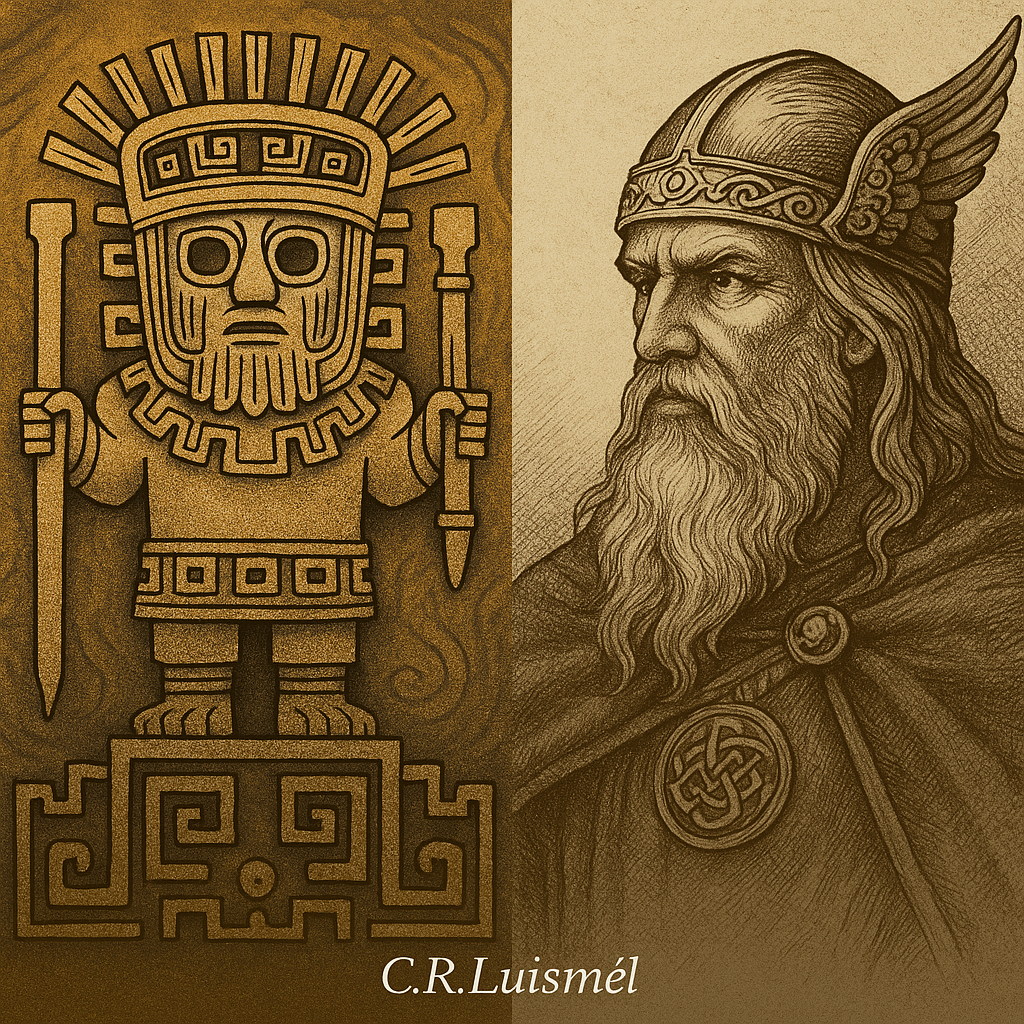
I once came across some rather bold theories suggesting that the Incas —the imperial ruling class among the Quechua peoples at the time of the Europeans’ arrival— were actually Vikings or their descendants, who arrived around the year 1000, sparking the legend of Manco Cápac and Mama Ocllo emerging from Lake Titicaca.
Others claim they might have been Egyptians, but that theory is easily dismissed: by the year 1000, Egypt hadn’t built pyramids for a very long time, had no pharaohs, and was under a caliphate dominated by Arab language and culture.
Some clues that fuel these far-out ideas
- It’s been proposed that the language of the Incan elite was actually foreign to the common people, spoken only among the nobility. Quechua might not have been the native language of the Incas, but the one they adopted to govern.
- Certain chronicles describe the Incas as having distinct stature and features, though by the time Europeans arrived, five centuries of Incan dynasty had already passed — plenty of time for intermingling with local groups if they were originally outsiders.
The Viking migration hypothesis
One (admittedly speculative) theory goes like this:
A group of Vikings may have reached North America around the year 1000, when tribes and civilizations were scattered across the land. Slowly, they could have made their way down through Central America, finally arriving in South America and, decades later, establishing an empire in the Andes.
This is sometimes offered as an explanation for similarities in architecture, astronomy, or rituals among the Incas, Mayas, and Aztecs.
Some points (highly speculative) in favor
While there’s no sign of runic writing or obvious Viking art in the Incan world, if someone wanted to play devil’s advocate for the theory, they might say:
- The last Incas were described as taller individuals, in contrast to the Quechuas and other local communities, who rarely exceeded about 1.5 meters.
- The depiction of the god Viracocha bears a distant resemblance to some Nordic figures.
- The symbols and designs in Incan imperial clothing could be interpreted (very generously) as stylized echoes of medieval Nordic origins.
- And, as a purely anecdotal point: the very word “Inca”, often written by chroniclers as “Inga,” has a playful ring that recalls Vik-Inga.
Of course, all this remains firmly in the realm of hypothesis.
Long before the Incas…
It’s worth remembering that long before the Incas, there were even more astonishing cultures for their time, like those of the early horizon periods: Chavín, Mochicas, Wari, Tiwanaku, whose achievements continue to amaze the modern world.
— LMCR
2022.08.10