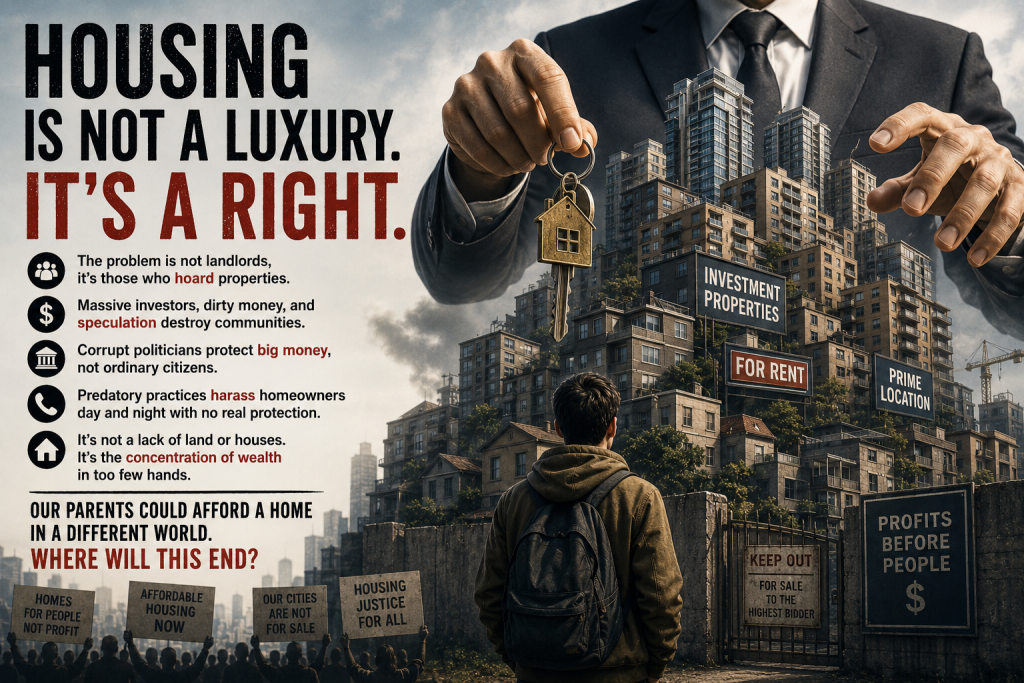
I applaud the young people all around the world for taking to the streets and speaking out about a problem that is no longer local, but global.
However, I believe there is an important distinction worth making.
Many people direct their anger toward landlords or individuals who rent out properties. But not every landlord is the problem. Sometimes it is simply someone who worked hard, managed to acquire a second property, and rents it out as a way to earn additional income or secure their retirement.
The real problem begins when housing stops being treated as shelter and starts being treated purely as a mechanism for financial domination.
When massive investors, corporations, or international conglomerates begin purchasing large amounts of property, prices rise far beyond what ordinary citizens can afford. Entire communities become economically displaced from the very cities where they were born and raised.
And in some cases, the situation becomes even darker.
Around the world, real estate has also become a vehicle for laundering dirty money, hiding questionable fortunes, or moving capital through opaque international structures that are almost impossible for ordinary people to track or challenge.
Meanwhile, politicians who should protect citizens often become more responsive to powerful financial interests than to the people they represent.
In the United States, a country that proudly defends the ideals of the free market, predatory housing practices have existed for years. If you own property, you may constantly receive aggressive phone calls, text messages, emails, letters, and advertisements pressuring you to sell your home — especially if investors suspect financial difficulty.
And once these systems become normalized, they become difficult to regulate.
Every time someone proposes protections for ordinary families, the response is immediate:
“government intervention,”
“attacks on the free market,”
“socialism.”
Meanwhile, property taxes continue rising, new financial burdens appear, and even inheriting a family home is becoming increasingly difficult for younger generations.
The problem is not that the world has run out of land.
The problem is not that humanity lacks the ability to build homes.
The problem is the growing concentration of property in fewer and fewer hands — often fueled by speculative capital, international funds, political influence, and sometimes even money of questionable origin.
Our parents and grandparents were often able to own homes not necessarily because they were smarter or worked harder than younger generations, but because they lived in a completely different economic reality.
Today, many young people work full time and still feel permanently locked out of ownership.
That frustration is real.
And perhaps the most important question is this:
Where will all of this lead us?
CRLuismël